Thankyou, Dan and Krisie

A Year in Paarl
A I Perold's
A Treatise
on Viticulture
A I Perold (1880-1941) was South Africa's first Professor of Viticulture and Oenology. He dedicated himself to improving the quality of grapes for wine, brandy and the table. He studied wine and brandy production in Europe, imported more than 60 varieties to the Cape and bred new ones. Perold said this book “is intended to serve both the student and the practical grape-grower. There are in it technical passages that will appeal more to the student, e.g. the chapters dealing with the biology of the vine, its external and internal morphology, the theory of grafting. My remarks on the practice of viticulture, such as those dealing with the propagation, manuring and pruning of the vine, the production of table grapes for export, will, it is hoped, assist the practical grape-grower as well as the student.” This is a newly typeset reprint, not a photocopy. Text on the 712 pages have been aligned to match the original pagination so any external references to pages in the Treatise will be valid in this edition
Available in paperback and hardback editions. 712 pages
with
A I Perold
Dr Perolds report on his Paarl experiments 1915 - 1916 reprinted with glossary, introduction and brief biography. Fascinating historical document on viticulture for wine and table grapes, wine and brandy making.


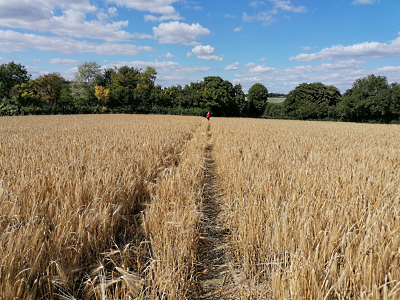
Circular walk from Flamstead.

This pretty path, heading in the direction of Redbourn, unfortunately ended at a road, so we turned back.

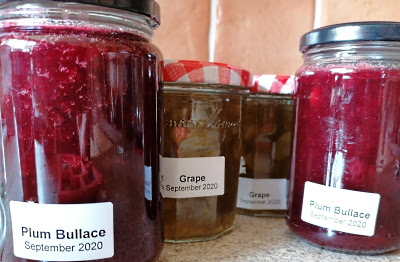
But we did pick 1.6Kg on these Bullaces, 1Kg was made into jam, the red stewed with windfall apples.
Another warm sunny day with a refreshing breeze. Our second visit to Panshanger and we decided to take the northern bridleway and to walk around the northern perimeter.

We gorged on plump blackberries growing in abundance along the paths.

Then we followed the path southward to the ruins of the great house.

A photograph on the ruins' surrounding fence showed what it had been.

But the view south, landscaped by Humphrey Repton was still there with the Mimram widened.

A bit further on through the trees we saw the remains of the Orangery

and then the Great Oak


and then we walked down to the rivers and lakes, through a field of English Longhorn cattle.